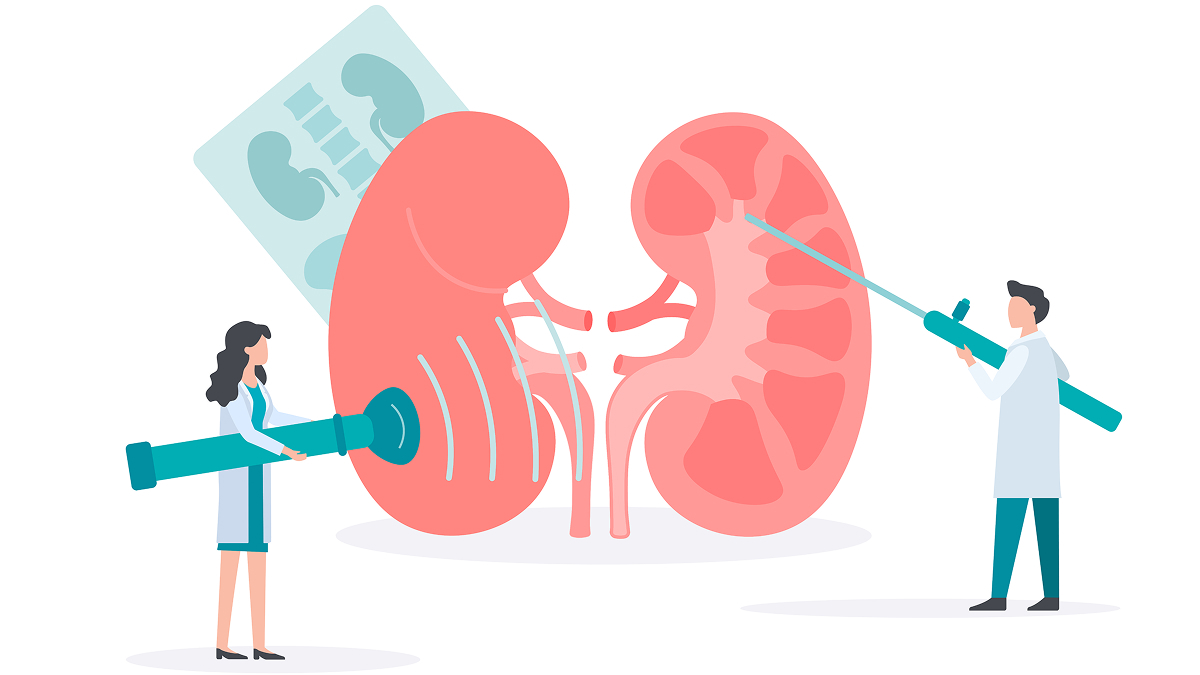

Renal denervation (RDN) is a procedure for hypertension that will not come down with medication and lifestyle changes alone. RDN moved into mainstream practice when the U.S. Food and Drug Administration (FDA) approved two treatment systems in November 2023. Medicare covers RDN under specific conditions, which changes the calculus for practices weighing whether to build their hypertension treatment program around it. What providers implementing renal denervation quickly learn is that the procedure lowers blood pressure gradually over weeks and months, not overnight, which makes structured post-procedure remote monitoring a key part of the therapy. This post explains what renal denervation is, where its coverage stands in 2026, and where remote patient monitoring (RPM) fits in the care pathway, both in identifying candidates for the procedure and as the formalized final step after it.
What Is Renal Denervation, and Who Is it For?
Renal denervation is a minimally invasive procedure that disrupts overactive sympathetic nerves in the renal arteries, which help regulate blood pressure. The procedure is delivered by catheter, typically takes one to two hours, and usually allows same-day discharge, as Cleveland Clinic and program descriptions like the one at VA Boston Healthcare System both describe. It is positioned as an adjunct to pharmacotherapy and lifestyle modification.
Renal denervation is considered for adults whose hypertension remains uncontrolled despite lifestyle changes and antihypertensive medications. Eligibility is confirmed through a structured workup that generally includes office and home or ambulatory blood pressure measurement, laboratory testing, and screening for secondary causes of hypertension.
The evidence base is what moved renal denervation from a contested idea to an approved therapy. The American Heart Association's 2024 scientific statement, Renal Denervation for the Treatment of Hypertension (Cluett et al., Hypertension 2024;81:e135-e148), concluded that renal denervation is effective across mild, moderate, and resistant hypertension, with a blood-pressure-lowering effect comparable to that of one effective antihypertensive drug, and a favorable safety profile with a very low incidence of major adverse events. The same statement is careful about a point that shapes everything downstream: Individual response varies, and the effect is delayed and gradual. Registry and trial follow-up show blood pressure declining most steeply in the first three to six months and continuing to fall more slowly after that. That gradual, variable onset is the clinical reason monitoring matters.
How is Renal Denervation Coded and Covered in 2026?
Renal denervation is currently reported with Category III Current Procedural Terminology (CPT) codes. The two relevant codes are 0338T for a unilateral procedure and 0339T for a bilateral procedure. Category III codes are temporary tracking codes the American Medical Association (AMA) assigns to emerging procedures.
The coding picture is actively changing, and this is where the proposed-versus-final distinction matters. An earlier effort to create permanent Category I codes was declined at the CPT Editorial Panel's September 2024 meeting, but interventional societies resubmitted for the code change application, and the agenda for the Panel's September 2026 meeting includes a proposal to establish Category I codes for transcatheter renal sympathetic denervation and delete Category III codes 0338T and 0339T.
Coverage is the more consequential 2026 development. The Centers for Medicare & Medicaid Services (CMS) issued National Coverage Determination 20.40, covering FDA-approved renal denervation for uncontrolled hypertension under Coverage with Evidence Development (CED). CED is conditional: It applies when the procedure is furnished within a CMS-approved study that meets the criteria in the determination, not as blanket coverage for any patient. Several private payers have since followed with their own coverage decisions, which is what has begun to make access more consistent across health systems. For practices, a reimbursement pathway now exists where none did before, and that the pathway comes with documentation and follow-up expectations.
Where Does Remote Patient Monitoring Fit in the Renal Denervation Care Pathway?
Remote patient monitoring fits the renal denervation pathway at both ends, and its first role comes before the procedure. Renal denervation candidacy, and the coverage attached to it, rests on showing that a patient's blood pressure stays uncontrolled despite lifestyle changes and an adequate medication regimen. Sustained home blood pressure data is well suited to documenting that pattern over time. Used across a hypertensive panel, a remote patient monitoring program also works as a case-finding tool, surfacing the medium- and high-acuity patients who remain above target on therapy, the group most likely to warrant evaluation for renal denervation.
Remote patient monitoring is also the formalized final step in the renal denervation care pathway. The VA Boston Healthcare System model makes this explicit: After the procedure and same-day discharge, patients are monitored remotely to track recovery and blood pressure trends, then seen within roughly three months by the specialty hypertension clinic to reassess blood pressure and adjust medications.
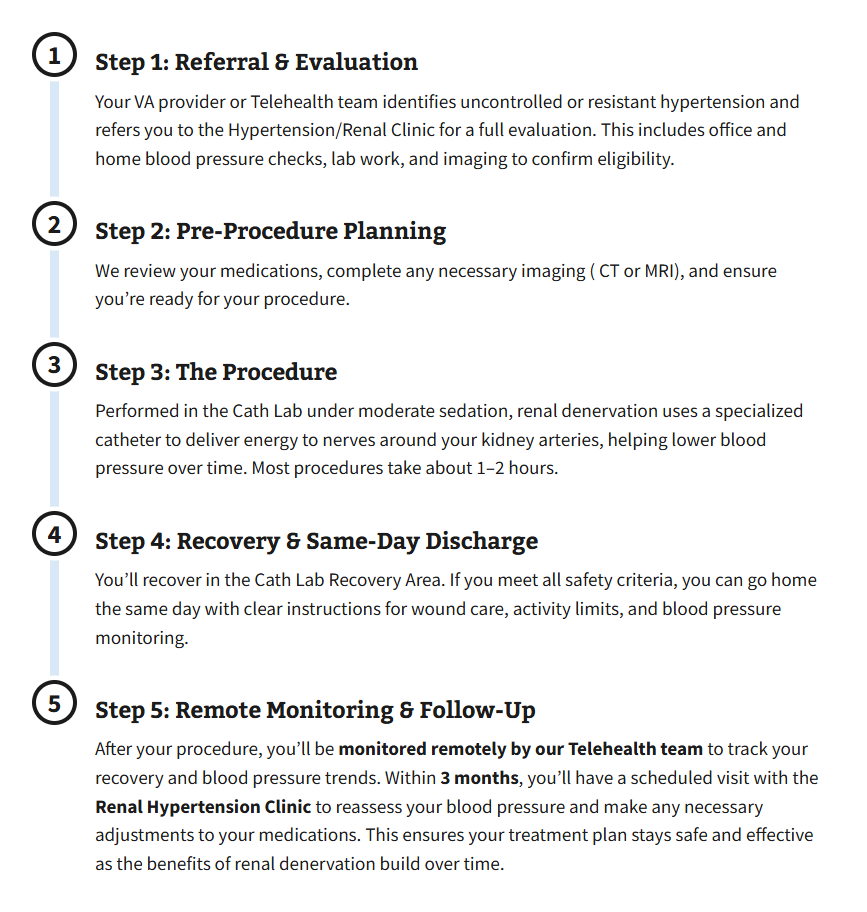
The five-step renal denervation care pathway at VA Boston Healthcare System, with remote monitoring as the final step. Source: VA Boston Healthcare System.
Two clinical data streams matter in that window: blood pressure trends and recovery or symptom surveillance. Both are precisely what an RPM program is built to capture between visits.
Why Does a Gradual Blood Pressure Response Make Trend Monitoring Essential?
A gradual, variable blood pressure response makes trend data more decision-relevant than isolated office readings. Because the effect of renal denervation builds over months, a single in-office measurement taken weeks after the procedure can misrepresent where a patient is actually heading. Continuous home readings show the trajectory, which supports one of the pathway's core principles: avoiding premature changes to antihypertensive therapy. Monitoring post-op helps avoid unnecessary early medication changes because the blood pressure effect builds over time. Trend data is what lets a physician adjust antihypertensive medications with evidence rather than guesswork.
How Does RPM Support Post-procedure Recovery?
Remote patient monitoring supports post-procedure recovery by surfacing complications and concerning symptoms without requiring an in-person visit. In the weeks between the procedure and the scheduled specialty follow-up, RPM keeps a clinical team connected to the patient, so a problem can be caught and triaged early rather than waiting for the next appointment.
Final Thoughts on the Intersection of RPM and Renal Denervation
Renal denervation interrupts renal sympathetic signaling in one to two hours, but the blood pressure benefit accrues over months and varies from patient to patient, which means the work of confirming that the therapy is doing its job happens after discharge. That is why pathways built by experienced programs treat remote patient monitoring as an integral step rather than optional follow-up. Renal denervation with structured RPM is an integrated care model.
If you are building or expanding a program around renal denervation and want the monitoring side handled well, book a consultation with Prevounce to talk through devices, workflow, and compliant RPM for hypertension.
Frequently asked questions
Is renal denervation covered by Medicare?
Yes, with conditions. The Centers for Medicare and Medicaid Services covers FDA-approved renal denervation for uncontrolled hypertension under Coverage with Evidence Development, meaning coverage applies when the procedure is furnished within a CMS-approved study that meets the National Coverage Determination's criteria. Several private payers have since issued their own coverage decisions.
How is remote patient monitoring used before renal denervation?
Before the procedure, remote patient monitoring provides the sustained home blood pressure data that documents hypertension remaining uncontrolled despite lifestyle changes and medication, which is central to establishing candidacy and meeting coverage criteria. Used across a hypertensive panel, it also helps identify the medium- and high-acuity patients who stay above target on therapy and who may warrant evaluation for renal denervation.
What does remote patient monitoring track after renal denervation?
RPM after renal denervation tracks home blood pressure trends and supports recovery and symptom surveillance in the weeks after the procedure. Since the blood pressure effect of renal denervation builds gradually, trend data collected over time is more informative than any single office reading.
How long does renal denervation take to lower blood pressure?
Renal denervation lowers blood pressure gradually rather than immediately, with reductions typically steepest in the first three to six months and continuing to build over time. This delayed, variable response is the reason post-procedure blood pressure trends matter more than any single office reading.
Can remote patient monitoring be used after renal denervation?
Yes. RPM fits the post-renal-denervation period well because it captures home blood pressure trends and supports recovery surveillance between the procedure and the scheduled specialty follow-up. Patients whose hypertension remains uncontrolled after the procedure generally qualify for Medicare RPM when standard program requirements are met.
Do patients qualify for Medicare RPM after renal denervation?
Patients whose hypertension remains uncontrolled after renal denervation generally qualify for Medicare remote patient monitoring, since uncontrolled hypertension is a qualifying condition for RPM. Billability in any specific case still depends on meeting standard RPM requirements, including an established patient relationship and device-data thresholds.
CPT Copyright 2026 American Medical Association. All rights reserved.
CPT® is a registered trademark of the American Medical Association.
* Disclaimer: The above information is for informational purposes only and does not constitute legal or other professional advice. Billing and coding requirements — especially in the telehealth space — can change and be reinterpreted often. You should always consult an attorney and/or medical billing professional prior to submitting claims for services to ensure that all requirements are met.