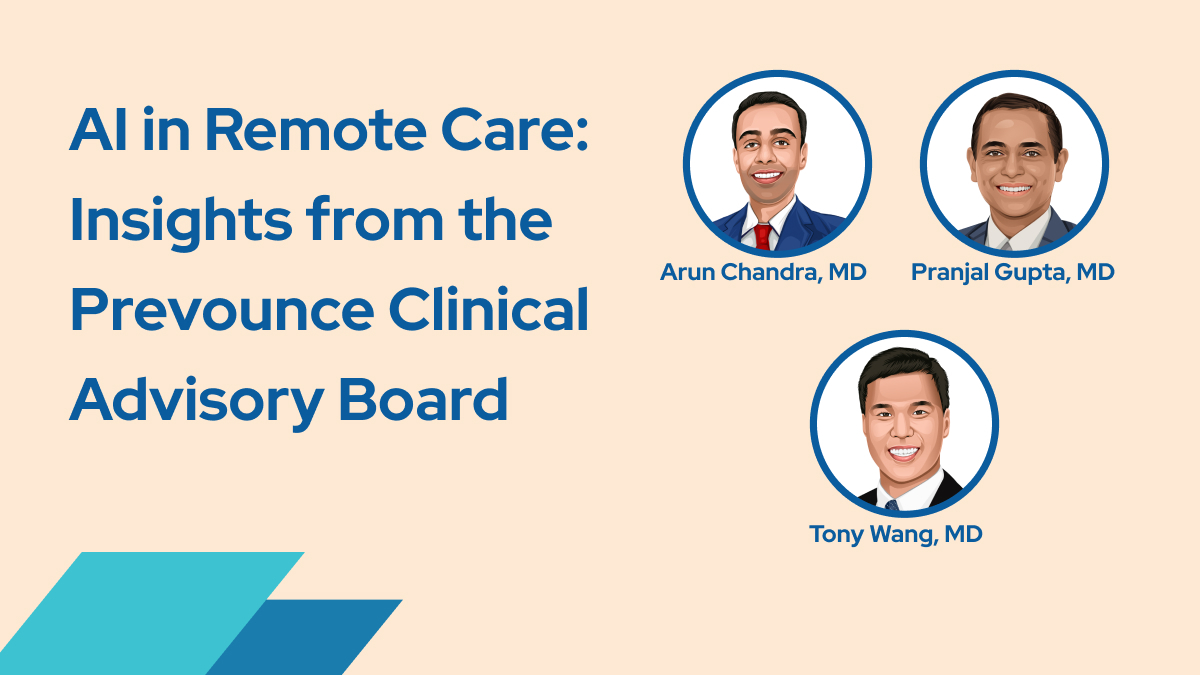
The Prevounce Clinical Advisory Board looks at emerging trends in healthcare, focusing not only on the opportunities, but also the obstacles for clinicians looking to deliver impactful remote care. In this second discussion of 2025, the focus of this board was on artificial intelligence (AI) in healthcare, its abilities to address the needs of remote care teams, and its future potential to overcome the challenges facing clinicians. Note: Read highlights from the first discussion on remote patient monitoring (RPM) adoption here.
I had the privilege of facilitating this second conversation as the Clinical Lead of our board. I was joined by Pranjal Gupta, MD, and Tony Wang, MD, who each contributed valuable experience and insights. Below are some key takeaways from our recorded discussion on the transformative potential of AI in RPM, along with a look at its current limitations.
AI’s Promise: Managing the Data Deluge in Healthcare
Healthcare is experiencing an explosion of data, from patient vitals to clinical documentation, lab reports, and EHR records. AI is proving to be a powerful tool for synthesizing this information, identifying trends, and enabling care teams to act on insights more efficiently and accurately.
Use Case: AI Insights in the Prevounce Platform
At Prevounce, care teams are already applying AI-driven insights within our platform to improve outcomes in remote care. These tools help detect abnormal patterns in RPM data, trigger alerts for timely interventions, and reduce the administrative burden on providers.
Transparency and Reliability of AI Models Is Paramount
Providers should clearly understand how AI tools generate recommendations in order to trust and effectively use them. If the technology functions as a “black box,” without clear reasoning or validation, it can undermine provider confidence and slow adoption.
Human Oversight Is Critical
Even with powerful tools, AI is not a replacement for clinical judgment. Human oversight remains essential. Experienced providers can recognize context and nuance that algorithms might miss. Until AI systems are thoroughly validated and regulated, they should complement — not replace — decision-making.
Final Thoughts From the Clinical Advisory Board: The Role of AI in Healthcare
AI tools show incredible promise for assisting clinicians overwhelmed by massive amounts of data and administrative overload. To ensure long-term success, systems must be reliable, transparent, and guided by clinical expertise.
Empowering Your Care Management Program With AI
For organizations with remote care management programs interested in leveraging AI to improve quality and efficiency, the experts at Prevounce are here to help. The Prevounce platform is a comprehensive remote care management solution equipped with integrated AI tools that assist care teams with data analysis and actionable recommendations to support improvements in areas like remote patient monitoring, chronic care management, annual wellness visits, and preventive services. Schedule a consultation to learn how Prevounce and its AI tools can make your practice more efficient.